SUP Pump vs Tire Inflator: Why PSI Alone Is Not Enough
When comparing a SUP pump vs tire inflator, one question comes up again and again: if a tire inflator can reach a much higher pressure, why not use it to inflate a paddle board?
The short answer is that inflating a SUP requires more than pressure. A paddle board needs a large volume of air at the beginning and enough pressure at the end. Tire inflators can usually produce high pressure, but their airflow is relatively low. General-purpose blowers and vacuums can move plenty of air, but they normally cannot reach the 12–15 PSI required by most SUPs.
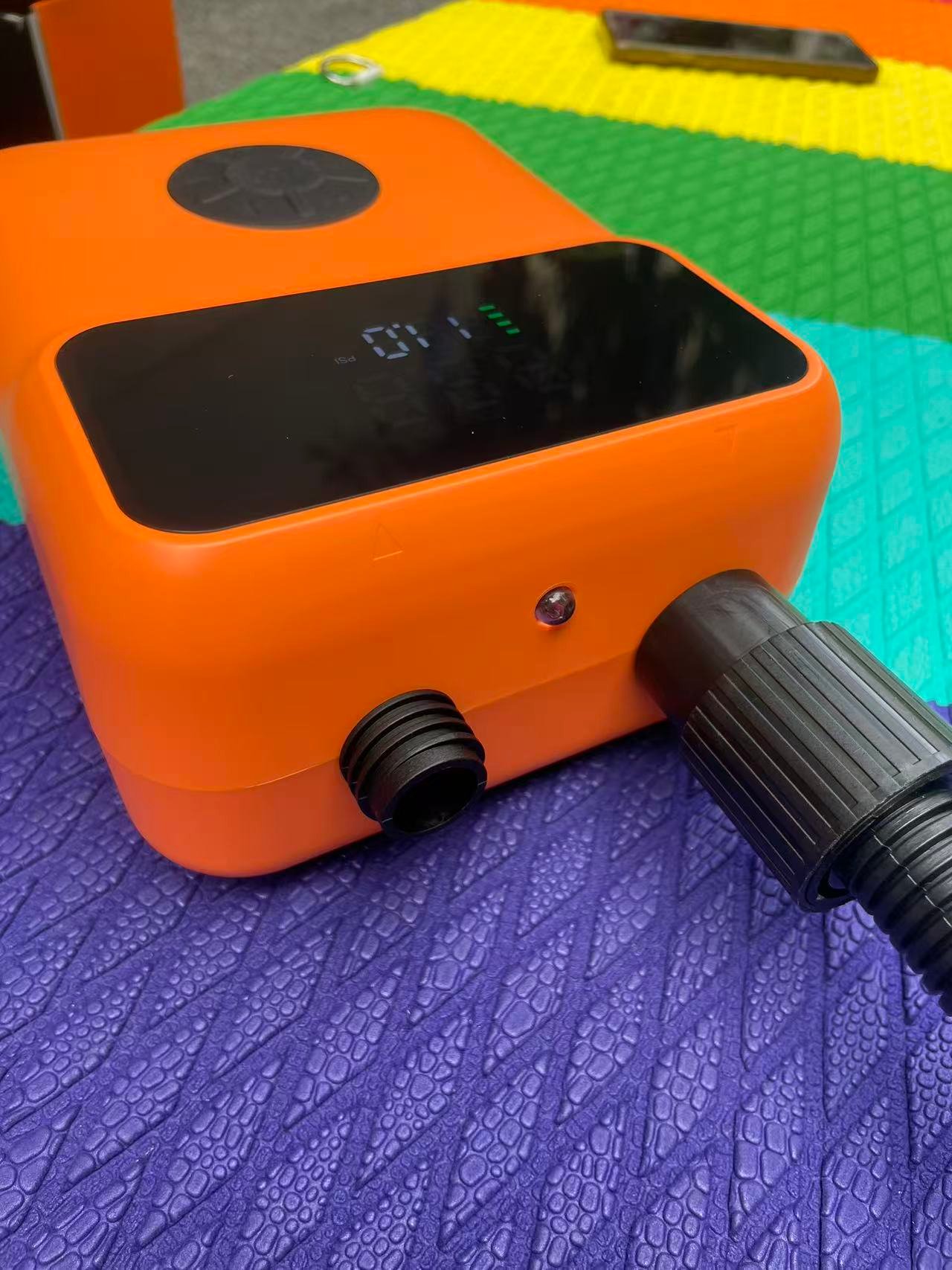
When choosing an electric SUP pump, look beyond the maximum PSI. You should also consider:
- Airflow during the low-pressure stage
- Pressure performance during the high-pressure stage
- Automatic shut-off
- Actual runtime and power options
- Cooling and continuous-duty capability
- Valve and adapter compatibility
Can You Use a Tire Inflator for a SUP?
In theory, some tire inflators may be able to add air to a SUP slowly if you have the correct adapter.
In practice, however, an ordinary tire inflator is usually not suitable for inflating a completely deflated SUP from empty.
A SUP has a large internal volume and needs a substantial amount of air during the first stage of inflation. Tire inflators are designed mainly for car and bicycle tires, which have a much smaller volume but require higher pressure. Their airflow is therefore usually too low for efficient SUP inflation.
Using a tire inflator for a SUP can lead to:
- Very long inflation times
- Continuous heat buildup
- Activation of overheat protection
- Reduced motor life from extended operation
- Poor sealing between the adapter and the SUP valve
A compatible tire inflator may be useful for adding a small amount of pressure in an emergency. But if you need to inflate a SUP from empty, a dedicated electric SUP pump is normally the better choice.
Why Does a SUP Need Both High Airflow and High Pressure?
SUP inflation can be divided into two main stages.
Stage 1: Filling the Board Quickly
At the beginning, the board has almost no internal pressure, but it needs a large volume of air. Airflow is the most important factor during this stage. Higher airflow helps the board unfold and take shape more quickly.
Stage 2: Building Pressure
Once the board has taken shape, internal resistance begins to rise. High airflow alone is no longer enough. The pump must continue compressing the air until the board reaches the pressure recommended by the SUP manufacturer.
Most SUPs are commonly inflated to around 12–15 PSI, but you should always follow the pressure printed near the valve or stated in the product manual.
This is why a two-stage electric SUP pump works well: it uses high airflow at the beginning and then switches to a high-pressure stage to finish the job.
How Does a Two-Stage SUP Pump Work?
- Low-pressure, high-airflow stage: The pump moves a large amount of air so the board expands and takes shape quickly.
- High-pressure stage: As resistance increases, the pump switches to its high-pressure system and continues until it reaches the pressure you selected.
This combination provides both speed and final pressure, making a two-stage pump much more suitable for SUPs than a conventional tire inflator that focuses mainly on pressure.
Why Are Tire Inflators and SUP Pumps Designed So Differently?
A tire inflator and a SUP pump solve two very different inflation problems.
A car tire normally still contains air when the user checks it. In most household situations, the inflator only needs to add a small amount of air—for example, raising the pressure from 28 PSI to 35 PSI. It does not usually need to fill the tire completely from empty.
Because the air volume inside a tire is relatively small, many compact tire inflators provide airflow of around 30–40 L/min. Their main job is to produce high pressure, and some models are rated up to approximately 150 PSI.
A SUP presents the opposite challenge. It normally starts completely deflated and has a much larger internal volume. During the first stage, a SUP pump may need airflow of approximately 300–400 L/min to fill the board quickly and help it take shape.
Once the board begins to resist, the pump switches to its high-pressure stage. The airflow during this stage may fall to approximately 40–100 L/min while the pump continues building pressure.
| Requirement | Typical Tire Inflator | Typical Two-Stage SUP Pump |
|---|---|---|
| Starting condition | Usually adding air to a partially inflated tire | Usually inflating from completely empty |
| Main requirement | High pressure, relatively low air volume | High airflow first, then controlled pressure |
| Typical low-pressure airflow | Around 30–40 L/min | Around 300–400 L/min |
| Typical high-pressure airflow | Designed for small-volume tire inflation | Around 40–100 L/min, depending on the model |
| Maximum pressure | Some models are rated up to about 150 PSI | Commonly 20–22 PSI |
| Hose and internal air path | Generally narrower and designed for high pressure | Generally wider to move a larger volume of air |
These figures are typical examples rather than specifications for every pump. Always check the rated airflow, pressure and duty cycle of the individual model.
The hose, valve connector and internal air path are also designed differently. A SUP pump needs to move a large volume of air quickly, so it normally uses a wider hose and air channel. A tire inflator uses a smaller hose and connector designed for much higher pressure and a smaller air volume.
What About Pumps That Inflate Both Tires and SUPs?
Combination pumps that can inflate both tires and SUPs are available. They can be convenient when portability and carrying fewer devices are more important than maximum speed.
However, a combination pump must balance two very different requirements:
- Up to approximately 150 PSI for tires
- Several hundred litres per minute during the first stage of SUP inflation
A well-designed combination pump can handle both applications, but buyers should check more than the maximum PSI. They should also confirm:
- Low-pressure airflow
- High-pressure airflow
- Continuous working time
- Recommended cooling interval
- Hose and adapter design
- Automatic shut-off
- Whether the manufacturer provides real tests for both tires and SUPs
For occasional use, a properly designed combination pump may be practical. For frequent use, buying separate pumps is often the better choice.
A dedicated SUP pump will normally inflate a paddle board faster because its first stage is designed specifically for large-volume airflow. A dedicated tire inflator is better suited to producing much higher pressure through a smaller air path.
Using separate pumps also means that each motor, hose and pressure system works within the application it was designed for. This can provide more consistent performance and may support a longer service life, although actual durability still depends on product quality, cooling design and correct use.
What Do 20 PSI and 22 PSI Actually Mean?
A 20 PSI or 22 PSI rating normally indicates the pump’s maximum pressure. For a full breakdown of pressure ranges across inflatable types, see the electric air pump PSI guide. It does not mean that every SUP should be inflated to that pressure.
If your board manufacturer recommends 15 PSI, set the pump to 15 PSI. Do not inflate the board to 20 or 22 PSI simply because the pump can reach that level.
A higher maximum rating mainly gives the pump additional pressure capability and allows it to cover a wider range of high-pressure inflatables.
Before buying a pump, check:
- The recommended pressure for your SUP
- The pump’s maximum pressure
- Whether the pump can work reliably at your target PSI
- Whether it has a real-time pressure display and automatic shut-off
Never exceed the maximum pressure specified by the SUP manufacturer.
Why Is Automatic Shut-Off Important?
An electric SUP pump with an adjustable pressure setting can stop automatically when it reaches the selected PSI.
This helps to:
- Reduce the risk of overinflation
- Eliminate the need to watch the pressure display constantly
- Let you prepare your paddle, leash and other equipment while the pump is working
- Achieve more consistent pressure each time
Automatic shut-off does not replace correct setup. Always enter the pressure recommended for your board and make sure the hose and adapter are firmly connected.
Why Do Inflation Times Vary Between SUPs?
A claim such as “inflates a SUP in seven minutes” is only a reference. It cannot apply to every board.
Actual inflation time depends on:
- Board length, width and thickness
- Internal air volume
- Target pressure
- Whether the board starts completely empty
- Ambient temperature
- Remaining battery level
- Valve and adapter sealing
- Low-pressure airflow and high-pressure efficiency
- Whether the pump needs a cooling interval
When comparing pumps, check the size of the board used in the test, the target PSI and whether the pump was powered by its battery or a 12V vehicle outlet.
How Many SUPs Can One Battery Inflate?
The number of boards a cordless pump can inflate depends on board size, target pressure, battery condition, pump efficiency and ambient temperature.
The mAh rating can be a useful reference, but it does not directly tell you the actual runtime. Pumps may use different battery voltages, motor power levels and internal systems. Real continuous runtime and documented inflation tests are therefore more useful than the mAh figure alone.
A claim such as “up to four SUPs” must be understood together with its test conditions. It does not mean that every board, at every target pressure, can be inflated four times.
Battery consumption increases when:
- The SUP is larger
- The target pressure is higher
- The battery has aged
- The ambient temperature is very high or low
- The pump becomes hotter during repeated use
- The pump is also used for deflation
If you regularly inflate several boards, look for verified runtime, effective cooling and a model that can also use 12V vehicle power. Dual power means you can continue working from a vehicle outlet even if the internal battery runs low.
How Do You Check SUP Valve Compatibility?
Before buying a pump, check three things:
- The recommended pressure printed near the valve
- The shape and locking method of the valve
- Whether the pump includes the correct adapter
Many SUPs use an HR-style valve or a similar design, but valve-pin depth and sealing-gasket thickness can vary between brands.
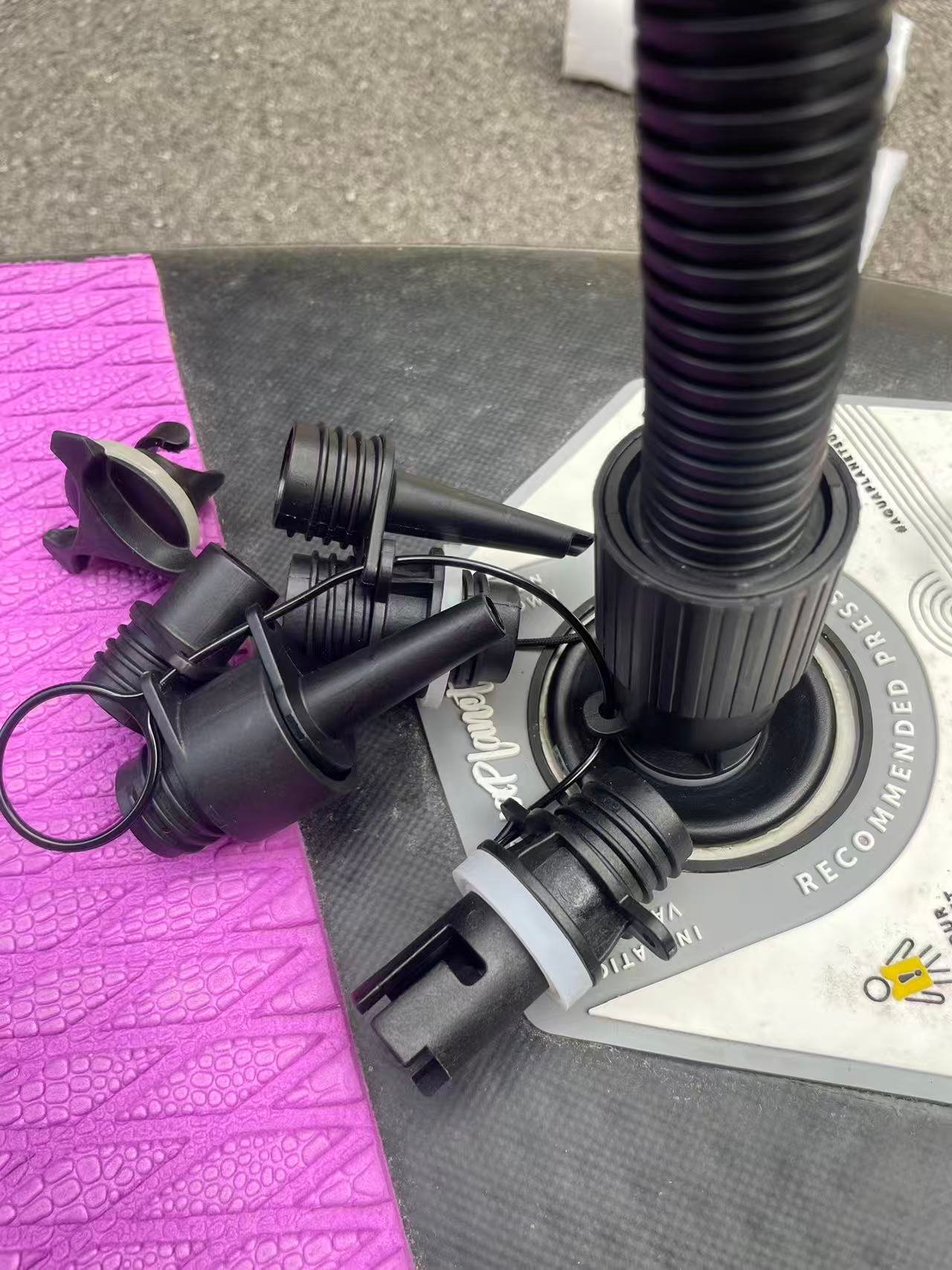
If you are unsure, send the supplier:
- A clear photo with the valve cap open
- A front-facing photo of the valve
- A photo of the pressure marking
- The SUP brand and model
Do not force an adapter that does not lock or seal correctly. A poor connection can cause leakage, the hose to detach or damage to the valve.
12V, Rechargeable or Dual Power: Which SUP Pump Should You Choose?
12V Vehicle-Powered SUP Pump
This option suits users who normally drive to the launch point.
- No dependence on an internal battery
- Suitable for repeated inflation sessions
- Works directly from a compatible vehicle outlet
Always confirm the pump’s voltage and current requirements and the rating of the vehicle outlet.
Rechargeable SUP Pump
A rechargeable model is suitable when you want to carry the pump closer to the water without remaining beside the vehicle.
- More flexibility at the launch site
- No cable connection during normal use
- Convenient for camping, lakes and beaches
Runtime varies with board size, target pressure, battery condition and temperature. Compare real continuous runtime, not only the mAh rating.
Battery + 12V Dual-Power SUP Pump
A dual-power pump combines cordless convenience with a backup power source. You can use the internal battery first and connect the pump to a compatible 12V vehicle outlet if the battery runs low. This is useful for families, clubs and rental operators inflating several boards.
M02PRO vs GR-133P: Which One Should You Choose?
| Comparison | M02PRO | GR-133P |
|---|---|---|
| Maximum pressure | 20 PSI | 22 PSI |
| Power options | Built-in battery + 12V vehicle power | Built-in battery |
| Battery capacity | 4000 mAh | 5000 mAh |
| Approx. runtime | About 30 minutes | About 40 minutes |
| Main applications | SUPs and other compatible inflatables | SUPs, air tents and other compatible inflatables |
| Key advantage | Dual power with 12V backup | 22 PSI range and broader applications |
| Best for | Users who value backup power and flexibility | Users who value runtime, pressure range or air-tent use |
Battery capacity is only one reference point. Actual continuous runtime and real inflation performance are more useful than comparing mAh figures alone.
Choose the M02PRO if you value:
- Approximately 30 minutes of runtime
- Battery and 12V vehicle dual power
- The ability to continue from a vehicle outlet when the battery runs low
- Flexible outdoor use
View the M02PRO 20 PSI Dual-Power Electric SUP Pump.
Choose the GR-133P if you value:
- Approximately 40 minutes of runtime
- A maximum pressure of 22 PSI
- SUP and air-tent applications
- 0.1 PSI pressure adjustment
- Inflation and deflation
View the GR-133P 22 PSI Air Tent & SUP Pump.
Before choosing either model, check your inflatable’s recommended pressure, volume, valve and continuous-use requirements. You can also browse all electric SUP pumps or use our Find Your Pump guide.
Frequently Asked Questions
Can a general electric air pump inflate a SUP?
A low-pressure electric pump may help the board expand, but it normally cannot reach the final pressure required by a SUP. A suitable SUP pump needs both high initial airflow and a high-pressure stage.
Can you use a vacuum or blower to inflate a SUP?
Some vacuums and blowers can move a large amount of air, but they normally cannot reach 12–15 PSI. They may help with the first stage only; a high-pressure pump is still required to finish inflation.
Can a tire inflator top up a SUP?
Some tire inflators may add a small amount of pressure if the pressure range, adapter and duty cycle are suitable. Because their airflow is low, they are generally not suitable for inflating a completely empty SUP.
Can a 20 PSI pump be used for a 15 PSI SUP?
Yes. Set the target to the 15 PSI recommended by the board manufacturer. The pump will stop when it reaches that setting. The 20 PSI figure is the pump’s maximum capability, not the pressure you must use.
Is a 22 PSI pump always faster than a 20 PSI pump?
No. Maximum PSI only indicates the pressure limit. Actual speed also depends on airflow, high-pressure efficiency, board size, target pressure and power condition.
Does a higher mAh rating always mean longer runtime?
No. Runtime also depends on battery voltage, motor power, system efficiency, target pressure and operating conditions. Real continuous runtime and documented inflation tests provide a better comparison.
Why does an electric SUP pump become warm?
The motor and cylinders generate heat during continuous operation, especially in the high-pressure stage. Keep all air inlets and cooling areas clear, follow the recommended cooling interval and never cover the pump while it is running.
Conclusion
Choosing an electric SUP pump is not simply a matter of comparing maximum PSI or battery mAh.
A suitable pump must move a large volume of air during the first stage and continue building pressure after the board takes shape. Automatic shut-off, valve compatibility, power options, real runtime and cooling performance all affect the user experience.
Choose the M02PRO if dual battery and 12V vehicle power are important to you. Its approximate battery runtime is 30 minutes. Consider the GR-133P if you need up to 22 PSI, approximately 40 minutes of runtime and compatibility with both SUPs and suitable air tents.
If you are still unsure, send us a photo of your inflatable, its dimensions, recommended pressure and valve. We can help you identify a suitable pump through our Contact Support page. You can also review our warranty information before ordering.