Choosing an electric air pump starts with two numbers: the pressure your inflatable needs and the airflow the pump can deliver. Maximum PSI tells you whether the pump can reach the firmness rating; airflow, often measured in liters per minute or cubic feet per minute, affects how quickly a large mattress, tube or boat fills. This guide organizes common inflatables by pressure range so you can compare pump categories before checking adapters and speed.
Always use the pressure printed on your inflatable label, valve sticker or user manual. The ranges below are practical starting groups recovered from the earlier InflatePump pressure-selection note; your exact product manual remains the final reference.
Quick pressure-range comparison
| Pressure range | Typical inflatables | What to compare on the pump |
|---|---|---|
| About 20 PSI / 1.37 bar / 137 kPa | SUP boards, kayaks, ocean boats, air tents, kites | High maximum PSI, correct valve adapter, gauge or auto-stop |
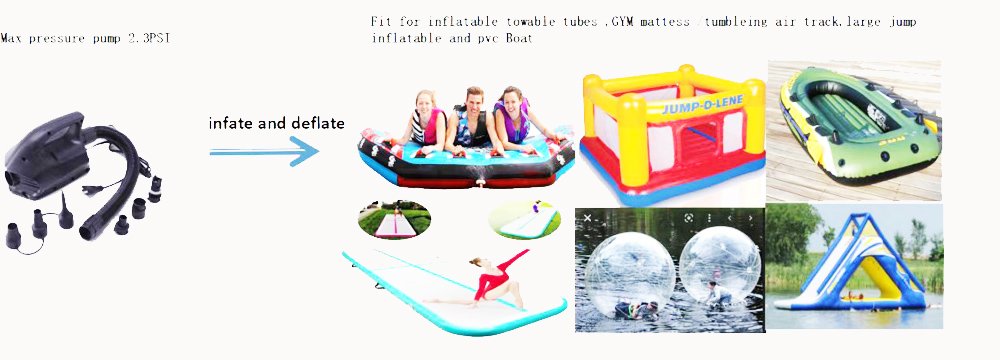
| About 2.5 PSI / 17 kPa / 17,236 Pa | Towable tubes, gym and yoga mats, PVC boats, large inflatables, sport balls | Balanced pressure and airflow, compatible nozzle |
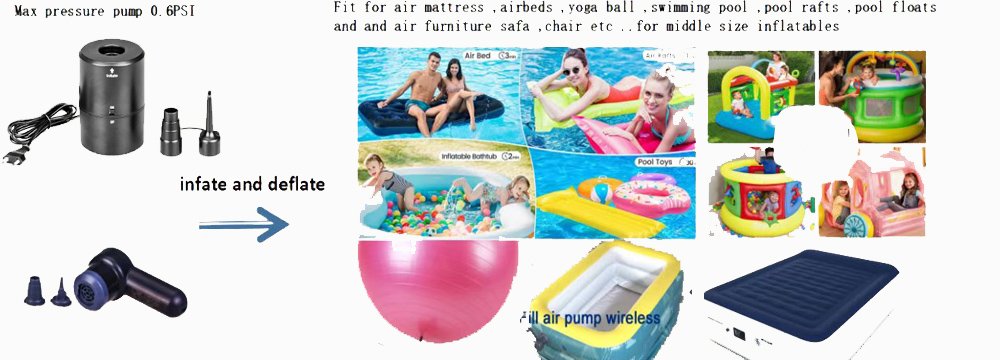
| About 0.6 PSI / 4,000 Pa / 4 kPa | Mattresses, chairs, sofas, pools, tubes, floats, furniture, storage bags | High airflow, gentle pressure control, deflation function |
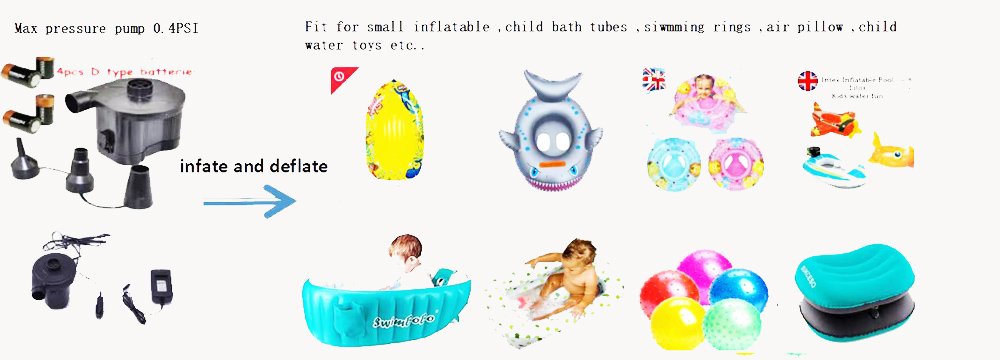
| About 0.4 PSI / 2,700 Pa / 2.7 kPa | Pillows, children’s swim rings, baby bath tubs, balls, small toys and floats | Low-pressure accuracy and small nozzle options |
1. High-pressure range: up to about 20 PSI (1.37 bar, 137 kPa)
High-pressure items need a pump that can reach a firm working pressure without stopping early. For SUP boards, inflatable kayaks, ocean boats, air tents and kites, compare the pump’s rated maximum PSI against the product manual and leave a reasonable margin rather than choosing the lowest rating that barely meets the number.
- Inflatable SUP paddle boards
- Inflatable kayaks and ocean boats
- Inflatable air tents
- Inflatable kites
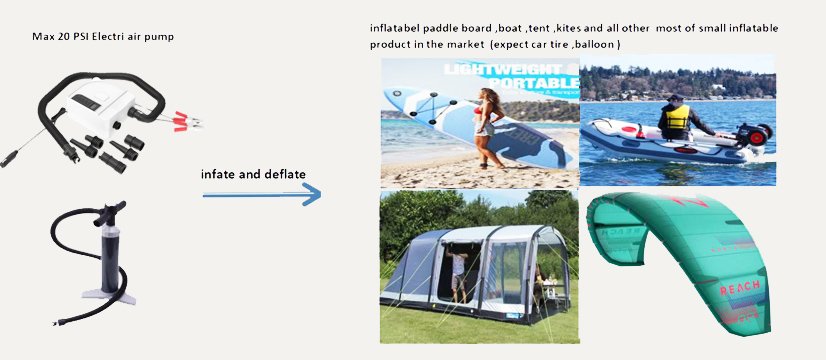
Check the valve adapter and O-ring before judging pump speed. A pump with a high PSI rating will underperform if the adapter leaks, the hose connection is loose, or the board valve seal is not seated correctly.
2. Medium-pressure range: up to about 2.5 PSI (17 kPa / 17,236 Pa)
Medium-pressure items usually need less PSI than a SUP board, but they can still move a large volume of air. Balance maximum pressure with airflow, especially for towables, air mats and larger PVC boats.
- Towable tubes
- Gym air mats and yoga exercise mats
- Normal PVC boats
- Large inflatable products
- Water sport balls
3. Low-pressure range: up to about 0.6 PSI (4,000 Pa / 4 kPa)
Mattresses, pool floats and inflatable furniture require low pressure but often need strong airflow. Overinflating a soft-sided item can stretch seams or damage valves, so use the product label as the target and watch the firmness rather than chasing a high PSI number.
- Air mattresses and beds
- Inflatable chairs and sofas
- Swimming pools and tubes
- Water floats and toys
- Inflatable furniture
- Vacuum storage bags
- Adult pool floats and toys
4. Very-low-pressure range: up to about 0.4 PSI (2,700 Pa / 2.7 kPa)
Small and soft items use the lowest pressure group. They often need small nozzle adapters and controlled airflow; a high-pressure pump without careful supervision can overfill thin vinyl or fabric quickly.
- Air pillows
- Children’s swimming rings
- Baby bath tubs
- Inflatable balls
- Kids’ small inflatable boats, floats and water toys
How to choose an electric air pump in six steps
- Find the recommended PSI, bar or kPa on the inflatable label or manual.
- Choose a pump whose maximum pressure covers that requirement with a sensible margin.
- Compare airflow for large low-pressure items, where volume matters more than high PSI.
- Match the hose adapter, nozzle and valve seal before comparing inflation time.
- Check the power source, cooling or duty-cycle instructions, auto-stop feature and deflation capability.
- Inflate a short test session and listen for leaks at the hose, adapter and valve.
Frequently asked questions
Does a higher-PSI pump work for a mattress?
Not automatically. A high maximum PSI does not always provide gentle low-pressure control. Mattresses and floats should be matched to a pump with suitable airflow and nozzle options; overpressure can strain seams and valves.
Why do low-pressure items still need a powerful pump?
Many mattresses, pools and floats hold a large air volume even at low PSI. Airflow determines how long that volume takes to move; a pump with strong airflow can finish faster than a small pump with a high maximum-pressure number.
What pump should I choose for a SUP board?
Use a high-pressure electric SUP pump rated for your board’s recommended working PSI. Verify the SUP valve adapter and seal condition, gauge accuracy and any auto-stop setting before each session.
Can one pump handle every inflatable type?
A multi-nozzle pump may cover several groups, but confirm its maximum PSI, airflow and adapter compatibility for each item. High-pressure SUP needs and low-pressure pillow needs should not be chosen from pressure rating alone.
Find the right pump before your next trip
Start with the inflatable type and required pressure, then compare adapters, airflow, power source and portability. If you are preparing a SUP, prioritize pressure rating and valve compatibility; if you are preparing a mattress or float, prioritize airflow and gentle control.