Why Is My Electric SUP Pump Taking So Long? Valve & O-Ring Fixes
If your electric SUP pump runs for 10 minutes but the board barely reaches 1 PSI, that is not normal. The most common cause is not the motor—it is air escaping where the pump adapter connects to the SUP valve.
A Real SUP Pump Question
“I’m using an electric air pump for the first time. The valve pin is up, and I push and turn the recommended short SUP adapter into place. I can hear air going in and coming out at the same time. After 10 minutes, the board is barely at 1 PSI. The pump is in SUP mode and set to 15 PSI. What am I doing wrong?”
Short answer: the adapter is probably not sealing correctly against the valve. Keep the center pin in the correct inflation position, then check the adapter style and the thickness of its white O-ring.
1. Check the SUP Valve Pin Position
Most SUP boards use a spring-loaded valve pin with two positions:
- Pin up: the valve is closed. Air can be pumped in, but it should not escape when the hose is removed.
- Pin locked down: the valve stays open for deflation. Air can escape freely.
For inflation, the pin is normally kept up. However, some adapters press the pin slightly while being twisted into place. That is acceptable only if the adapter and O-ring create a complete seal. If you hear a continuous hiss around the connection, stop and correct the seal before continuing.
2. Try a Different O-Ring Thickness
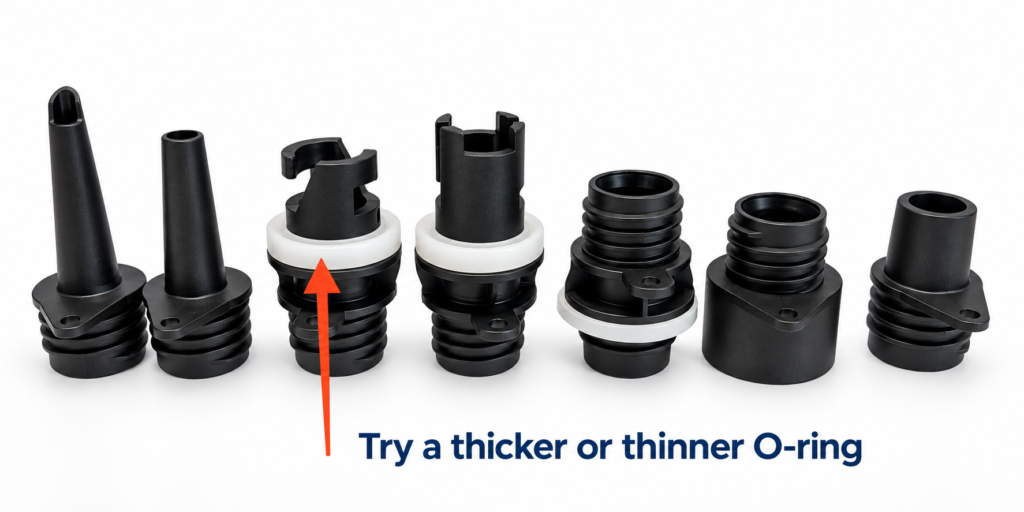
The white sealing ring on the adapter controls how tightly it fits against the valve. SUP valves are not all exactly the same depth. An adapter that works perfectly on one board may leak on another.
Some pump kits include replacement O-rings in several thicknesses, commonly around 2 mm, 3 mm, 4 mm, 5 mm or 6 mm. Check the accessories that came with your pump and compare them with the ring already fitted.
- If the adapter twists into the valve too easily and feels loose, try a thicker O-ring.
- If the adapter is extremely difficult to push and turn, try a thinner O-ring.
- Reconnect the hose and listen closely. The connection should feel firm, with no continuous air leak.
Do not force an oversized sealing ring. The correct fit should be secure without damaging the valve or adapter.
3. Try Another SUP Adapter
The adapter recommended in a pump manual is a starting point, not a guarantee for every board brand. If the “short adapter” leaks, test another compatible SUP adapter from the kit. Compare the locking tabs, insertion depth and O-ring contact—not only the opening diameter.
Before switching on the pump, confirm that both ends of the hose are tight. A loose connection at the pump outlet can produce the same symptoms as a leaking board valve.
4. Understand Two-Stage SUP Inflation
A proper electric SUP pump normally begins with high airflow to give the board its shape. It then switches to a lower-flow, high-pressure stage to reach the target PSI. The sound may change when the pump enters the second stage; that is normal.
What is not normal is remaining near 1 PSI after 10 minutes while air is audibly escaping. Correct the leak first. Increasing the pressure setting will not compensate for a poor seal.
5. Quick Troubleshooting Checklist
- Keep the valve pin up for inflation.
- Confirm that the correct pressure unit and SUP mode are selected.
- Tighten both ends of the inflation hose.
- Try another compatible valve adapter.
- Use a thicker O-ring if the adapter feels loose.
- Use a thinner O-ring if the adapter cannot lock properly.
- Check the hose and fittings for cracks or damage.
- Start with a fully charged battery or the correct power supply.
When Could the Pump Be the Problem?
If the adapter seals correctly, there is no audible leak, the hose is undamaged and the board still inflates extremely slowly, test the pump on another compatible inflatable. Persistent low airflow may indicate a blocked hose, damaged seal, low battery, pressure-sensor issue or internal pump fault.
For high-pressure boards, use a pump designed specifically for SUP inflation. See our electric SUP pump collection or review the M02PRO 20 PSI dual-power SUP pump. If you are unsure about valve compatibility, send us a clear photo of the valve and adapter before ordering.
Frequently Asked Questions
Should the SUP valve pin be up or down when inflating?
For most SUP valves, keep the center pin up. The closed valve accepts incoming air but prevents it from escaping when the hose is removed.
Why can I hear air leaking around the adapter?
The adapter may be the wrong style, may not be fully locked, or may need a thicker or thinner sealing O-ring.
Is 10 minutes to reach 1 PSI normal?
No. Inflation time varies, but staying near 1 PSI after 10 minutes usually indicates a major air leak, loose hose connection or unsuitable adapter.
Can I use any adapter that fits into the valve?
No. The adapter must match the locking tabs, insertion depth and sealing surface. A loose-fitting adapter can appear connected while still leaking air.